
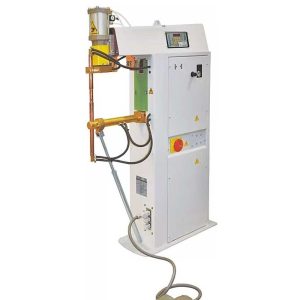
Production Engineering carries the complete TECNA Pedestal Welder line, covering three fundamental machine types: rocker arm welders, press type welders, and projection welders. Each type addresses a different set of application requirements, and each is available in both single-phase AC and three-phase MFDC (Medium Frequency DC) power configurations.

Press type spot welders replace the pivoting rocker arm with a straight linear electrode stroke – the upper electrode moves directly down onto the workpiece in a true vertical press motion. This linear action generates higher, more uniformly distributed electrode force compared to a rocker arm, and maintains that force consistently regardless of stack-up thickness variation. The result is superior weld quality on heavier gauge materials, multi-layer assemblies, and applications where electrode force consistency is critical to achieving a sound weld nugget. Available in AC and MFDC.
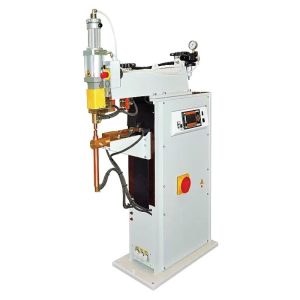
Projection welding concentrates welding current at small raised projections stamped into one of the parts. When the electrodes clamp the assembly and current flows, each projection heats rapidly and collapses into the mating surface, forming multiple weld nuggets in a single cycle. It’s the go-to process for attaching nuts, bolts, and studs to sheet metal, welding cross-wire assemblies, and any job that requires several precisely located welds at once. Available in AC and MFDC configurations.
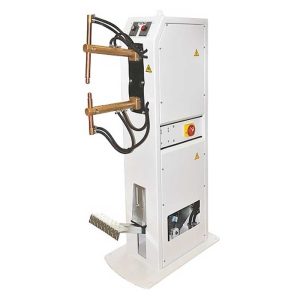
Rocker arm spot welders are a workhorse of general fabrication — simple, durable machines built around a pivoting upper arm. Press the foot pedal (or trigger the air cylinder or servo), and the arm swings the upper electrode down onto the workpiece with steady, even pressure. Because the arm pivots rather than plunges, it naturally follows the metal as it heats and softens, holding solid electrode contact from the first pulse of current until the nugget cools. That built-in consistency makes rocker arm machines a favorite for sheet metal work and thinner gauge materials, and their open throat design leaves plenty of room to maneuver larger or awkward parts. Available in AC and MFDC configurations.
Resistance spot welding and projection welding have been production joining processes for more than a century. Elihu Thomson patented the resistance welding principle in the 1880s, and by the early 1900s it was already in factory use. Both processes remain widely used because the physics are well understood and the results are repeatable. Copper-alloy electrodes apply force at the joint, a controlled current passes through the work, and the electrical resistance of the metal produces the heat that forms the weld. No filler metal, shielding gas, or arc is required.
In spot welding, electrode geometry and force localize the current. The usual joint is two overlapping sheets. More than two thicknesses can be welded, but that is not the preferred setup: current divides across multiple interfaces, nugget growth is uneven, and the process window narrows. Two-sheet joints give the most consistent nugget.
Projection welding uses the same machine principle, the current is localized by projections pre-formed in the part — embossed, coined, machined, or annular. Force and current is concentrated at those projection points. As the projections heat, they collapse and form the weld nugget. Several projections can be welded in a single stroke. This process is used for weld nuts, bolts, studs, brackets, and other fittings, as well as for sheet joints where electrode marking or access is a concern.
A pedestal welder is the stationary machine built for both. The frame is fixed to the floor, so electrode or die alignment and force stay the same from the first weld of a shift to the last. Force, weld time, and current are set on the control and held cycle to cycle, which is what high-volume spot and projection work requires.
AC machines run on conventional 50/60 Hz single-phase power. They are a proven, lower-cost choice for a wide range of standard spot and projection welding.
MFDC machines take a three-phase supply, invert it — commonly around 1,000 Hz, and in some designs up to a few thousand hertz — and rectify it to DC at the transformer secondary. The higher frequency allows a smaller, lighter transformer, faster current rise and fall, and tighter current control. In practice that means shorter weld times, less heat into the part, more consistent results on coated steels and aluminum alloys, a balanced plant load, and lower energy per weld. The faster rise is particularly useful in projection welding, where the projection has to heat and collapse before the surrounding material takes the current.
Typical resistance welder work includes automotive components and body assemblies, appliances, aerospace fabrication, HVAC and sheet metal, electrical enclosures, medical devices, and general stamped-metal assembly. TECNA pedestal welders are built for that duty, and Production Engineering stocks standard U.S. replacement components for immediate delivery.